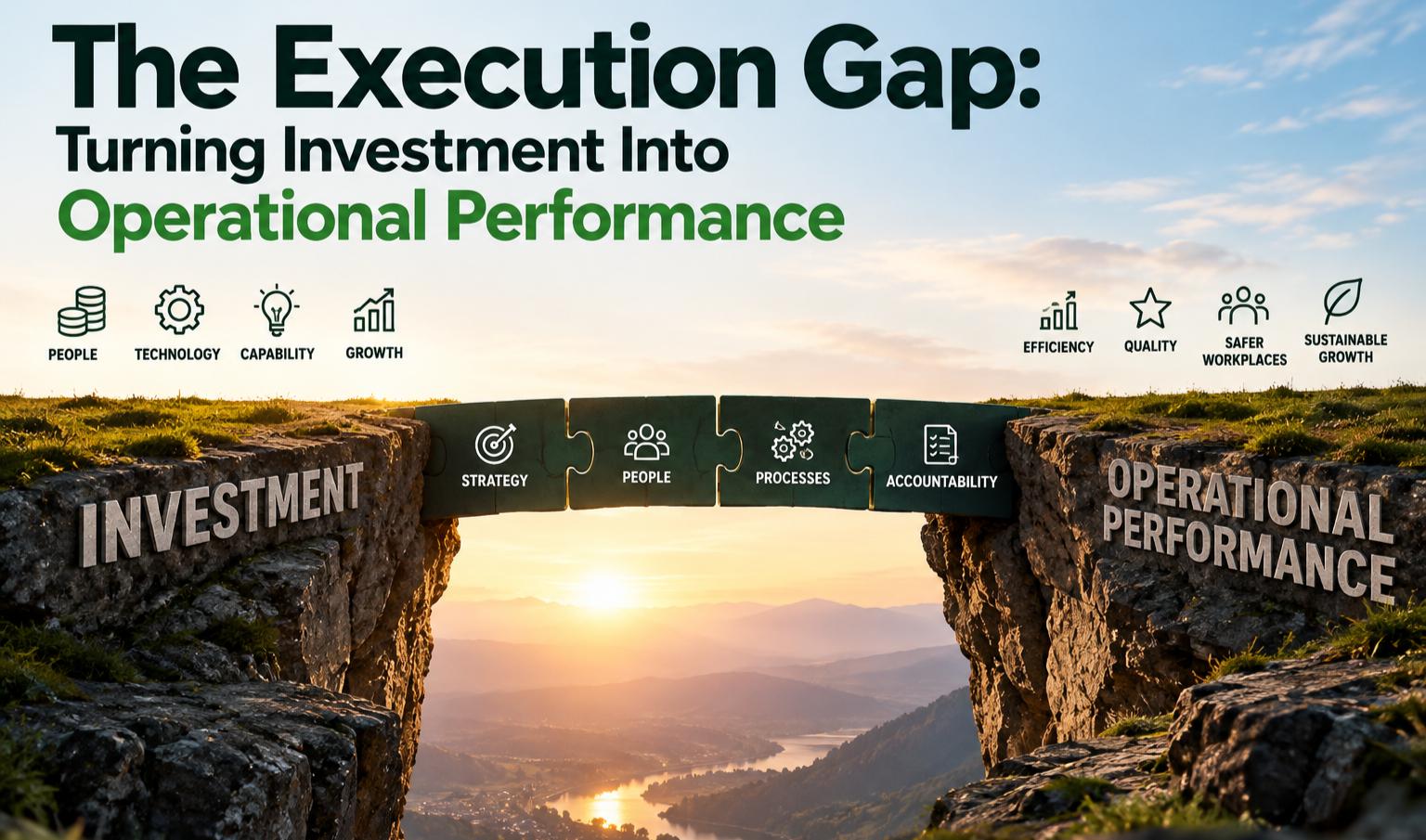
Organizations are investing aggressively in technology, infrastructure and growth.
AI spending continues to accelerate. Manufacturing capacity is expanding. Data center development is reaching unprecedented levels. Semiconductor investment continues to grow. Across industries, businesses are deploying capital to increase capacity, improve productivity and position themselves for the next phase of growth.
Yet investment does not automatically translate into performance.
In PwC's 2026 Digital Trends in Operations Survey, 89% of U.S. operations and supply-chain leaders said their technology investments had not fully delivered the expected results.
That disconnect deserves attention.
For many organizations, the next constraint on growth may not be access to technology, capital or opportunity. It may be the organization's ability to convert those investments into operational performance.
Investment Is Moving Faster Than Operating Models
AI provides perhaps the clearest example.
Gartner reported that only 22% of organizations have successfully scaled AI across multiple business units or adopted an AI-first approach, while 85% of functional leaders plan to increase AI spending in 2026.
PwC found a similar disconnect. Earlier this year, 56% of CEOs reported that AI had produced neither meaningful revenue nor cost benefits. Only 12% reported achieving both.
The technology itself is only part of the equation.
Organizations also have to redesign workflows, establish ownership, develop new capabilities and integrate technology into existing operations. Gartner's recent CEO research points directly to operating-model redesign as organizations look for greater value from AI.
The same principle applies beyond technology.
Whether an organization is opening a manufacturing facility, expanding infrastructure, entering a new market or implementing a major transformation program, investment creates potential.
The operating model determines how effectively that potential becomes performance.
Strategy Eventually Meets Operational Capacity
At the strategic level, growth initiatives can appear relatively straightforward.
Build the facility. Deploy the technology. Increase production. Expand into the market. Accelerate the program.
For the people responsible for execution, the reality is more complex.
They need the engineering and technical capacity to deliver. They need specialist expertise at the right time. They need existing teams to absorb new priorities without compromising current operations. And they need clear ownership across internal teams, suppliers and external partners.
This is where strategic ambition meets operational capacity.
An engineering team may be supporting current operations while commissioning a new facility. An infrastructure organization may be maintaining existing assets while deploying new capacity. An operations leader may be expected to implement automation while simultaneously improving productivity and controlling costs.
When strategic priorities expand faster than the organization's ability to absorb them, execution becomes the constraint.
More Resources Don't Necessarily Mean More Capacity
The obvious response to increasing workload is often to add people.
Sometimes that is exactly the right answer. But headcount and execution capacity are not the same thing.
Adding ten resources to an already stretched operation may increase theoretical capacity. If the existing leadership team must individually recruit, onboard, coordinate and manage those ten people, some of that capacity is immediately consumed by additional management requirements.
The same issue can arise as organizations add suppliers, contractors and specialist partners. Each may bring valuable expertise, but each can also create another relationship that someone inside the organization must coordinate.
Scaling therefore requires more than additional resources.
It requires an operating model that provides the capability the business needs while maintaining clear leadership, integration and accountability.
The Workforce Model Is an Operating Decision
Organizations need to be deliberate about how they build capability.
Some capabilities should be permanent and developed internally. Others may be specialized requirements associated with a particular technology, project or stage of expansion.
Some situations require individual expertise. Others require integrated teams capable of assuming responsibility for a defined area of delivery.
There is no single model that works for every requirement.
The more useful question is not simply:
How many people do we need?
It is: What capability does the business need to accomplish the objective, and what is the most effective way to build it?
That distinction is becoming increasingly important as technology changes the nature of work itself.
PwC's 2026 AI Jobs Barometer found that skills in the most AI-exposed jobs are changing more than twice as quickly as those in less-exposed roles. Demand is evolving not only for technical AI expertise, but also for human capabilities such as judgment, leadership and creativity.
Organizations therefore face two challenges simultaneously: building enough capacity to execute today while developing the capabilities they will need tomorrow.
Closing the Execution Gap
Business leaders appear increasingly aware of the challenge.
The Conference Board's Q3 2026 CEO survey found that 34% of CEOs expected to expand their workforce, up from 28% in the previous quarter. At the same time, organizations continue to navigate economic uncertainty, rising costs, technology disruption and rapidly changing workforce requirements.
That combination makes execution discipline increasingly important.
Organizations cannot eliminate complexity, but they can determine how that complexity is managed. They can be clearer about which capabilities are strategically important, where internal teams need additional capacity, when specialist expertise is required and who remains accountable as more resources and partners become involved.
Because strategy creates direction and investment creates opportunity.
Execution is what converts both into results.
At Mackin Talent, we partner with organizations to increase execution capacity through embedded and managed engineering, technical and operational teams, supported by dedicated leadership and accountability.
If your organization is investing in growth, expansion or transformation and execution capacity is becoming a constraint, let's talk about where additional capability could make the greatest difference.
Contact the Mackin Talent team