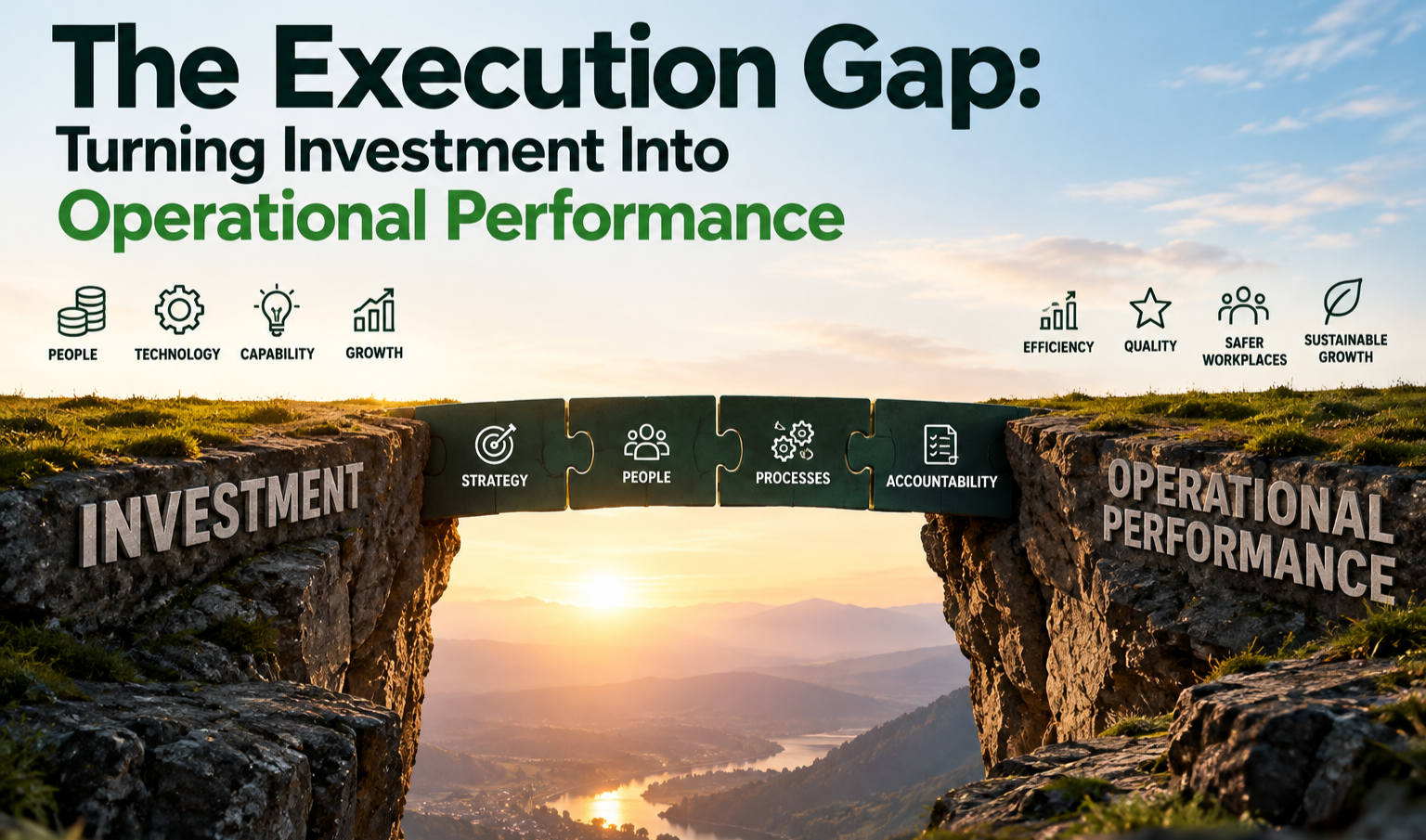

For many organizations, growth is no longer constrained by demand.
Across sectors such as data centers, semiconductor manufacturing, critical infrastructure, energy, and industrial development, investment levels remain strong and project pipelines continue to expand. The challenge facing many operational leaders is not finding opportunities. The challenge is executing against them.
Over the past several years, workforce availability has become one of the most significant factors influencing an organization's ability to deliver projects, expand operations, maintain schedules, and support growth initiatives. As a result, workforce scalability is increasingly moving beyond a workforce planning issue and becoming a strategic business consideration.
Organizations that can scale workforce capacity quickly and effectively are often able to move faster, maintain operational continuity, and capitalize on opportunities that competitors struggle to pursue.
Growth Has Become More Difficult to Execute.
Many industries are experiencing sustained investment and expansion. Data center development continues across major U.S. markets. Semiconductor manufacturers are building and expanding facilities to support domestic production initiatives. Infrastructure owners, utilities, and engineering firms are managing increasingly complex project portfolios while balancing delivery schedules, operational requirements, and workforce constraints.
At the same time, competition for experienced technical, operational, and project-based talent remains intense.
The challenge is not simply a shortage of people. In many cases, organizations are competing for individuals who can contribute immediately within highly specialized environments. Technical expertise, operational experience, safety awareness, and the ability to perform within established processes often matter as much as headcount itself.
As projects become larger and more complex, organizations frequently find themselves balancing aggressive growth objectives against finite operational resources.
Workforce Scalability Is Really About Execution Capacity
When workforce scalability is discussed, the conversation often focuses on recruiting, hiring timelines, or workforce planning.
Those factors matter, but they represent only part of the picture.
From an operational perspective, workforce scalability is fundamentally about execution capacity. It reflects an organization's ability to increase operational capability without disrupting ongoing performance, delivery schedules, safety standards, or customer commitments.
Organizations that scale successfully are not simply adding people. They are increasing their ability to execute.
That distinction becomes particularly important during periods of expansion. New facilities, major deployments, commissioning activities, manufacturing ramp-ups, and infrastructure projects all place additional demands on existing teams. Without the ability to expand workforce capacity effectively, growth initiatives can begin to compete with day-to-day operations for the same resources.
The result is often project delays, operational bottlenecks, increased pressure on key personnel, and reduced organizational agility.
The Cost of Limited Workforce Scalability
The impact of workforce constraints extends far beyond unfilled positions.
When organizations are unable to scale effectively, operational leaders are often forced to make difficult tradeoffs. Critical projects may be delayed. Existing teams may become overloaded. Managers may spend increasing amounts of time addressing workforce gaps rather than focusing on strategic priorities.
Over time, these challenges can affect delivery performance, operational continuity, employee retention, customer satisfaction, and organizational agility.
Many organizations have experienced situations where business opportunities existed, funding was approved, and projects were ready to proceed, yet execution was slowed because the required workforce capability was not available at the necessary scale.
In highly competitive industries, delays of even a few months can have significant consequences.
A Different Approach to Workforce Scalability
Leading organizations are increasingly viewing workforce scalability through an operational lens rather than solely through a hiring lens.
Rather than asking how quickly positions can be filled, they are asking how execution capacity can be increased while maintaining accountability, continuity, and performance.
The organizations managing growth most effectively tend to focus on execution capacity rather than headcount. They view workforce scalability as part of a broader operational strategy that includes workforce planning, operational support, project coordination, technical capability, and execution readiness.
This shift has contributed to the growth of embedded workforce models, operational support partnerships, managed capability programs, and other approaches designed to provide organizations with flexible access to workforce and operational resources.
The objective is not simply workforce augmentation.
The objective is to strengthen the organization's ability to execute.
When implemented effectively, these approaches can help organizations accelerate deployment schedules, support expansion initiatives, reduce operational strain on internal teams, and maintain focus on core business objectives.
Workforce Scalability as a Competitive Advantage
The organizations that will outperform in the years ahead are unlikely to be those with the largest workforce.
More often, they will be the organizations that can scale workforce and operational capacity most effectively while maintaining performance, accountability, and continuity.
Workforce scalability enables organizations to respond more quickly to opportunities, support growth initiatives with greater confidence, and maintain momentum during periods of change.
In that sense, workforce scalability is no longer simply an operational challenge to manage.
It has become a competitive advantage.
Many organizations continue to evaluate workforce scalability primarily through the lens of hiring.
Operational leaders often view the issue differently.
They understand that workforce scalability is ultimately about maintaining the capacity to execute.
As infrastructure investment accelerates, operational complexity increases, and project timelines continue to compress, the organizations that can scale execution capacity effectively will be better positioned to support growth, maintain continuity, and capitalize on opportunity.
The question is no longer whether workforce scalability matters.
The question is whether it has become a strategic advantage within your organization.
For organizations operating in complex, fast-moving environments, the answer can have a direct impact on growth, delivery performance, operational continuity, and long-term competitiveness.
If your organization is facing growth, expansion, deployment pressure, workforce constraints, or operational bottlenecks, now may be the time to evaluate whether workforce scalability is limiting your ability to execute.
Mackin Talent helps organizations increase execution capacity, maintain operational continuity, and deliver measurable outcomes through embedded workforce solutions, operational support, and scalable execution models designed for complex operational environments.
Contact a Mackin Talent Advisor to discuss your workforce, operational, and execution challenges.